

Discs are many kinds of bicycle components mounted on the hub of the wheel to provide braking power in the disc brake system. Discs are available in a variety of sizes to suit different terrain and riding habits. The simplest discs are made of stamped stainless steel, while more expensive ones have complex internal structures to improve braking performance and reduce weight. There are two common disc mounting methods - center lock and six-pin. In this article, we will list the main things you need to know about discs to help readers select the products they need.
1. What is a disc?
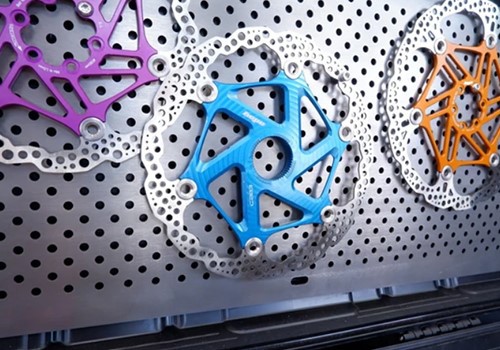
A disc is a metal disk mounted on a hub and is the main contact surface for the clamp brake. Different sizes and designs can be used for different purposes, some with the priority of providing maximum braking force, others with the priority of generating the least amount of heat, and of course some with the purpose of weight reduction.
2. Size of Discs
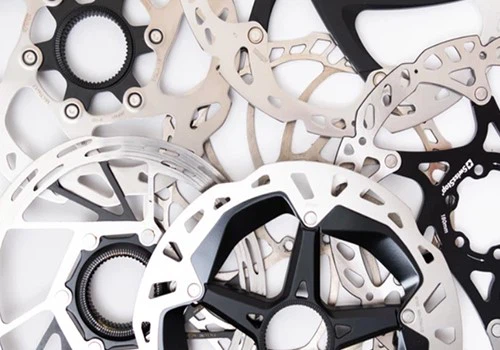
The role of discs is to slow down the rotational tendency of the wheelset, using clamps to make the discs squeeze the discs to generate friction. The larger the disc, the more heat is absorbed by the disc, the smaller the disc, the easier it is to overheat and thus produce heat exhaustion, and the braking power drops significantly or even disappears. Simply put, the larger the disc, the better the braking effect. However, not all vehicles and riders need maximum braking power, and in many cases it is important to find a three-way balance of braking power, brake feel and lightness.
Road bikes and cyclocross bikes generally use 140-160mm discs for adequate braking power and light weight, while mountain bikes generally use 180-220mm discs. Many mountain bikes use "big front and small rear", such as 200mm discs for the front wheel and 180mm discs for the rear wheel; nowadays, speed bikes also use discs of 200mm or more, and electric power bikes are also.
3. The design and material of discs
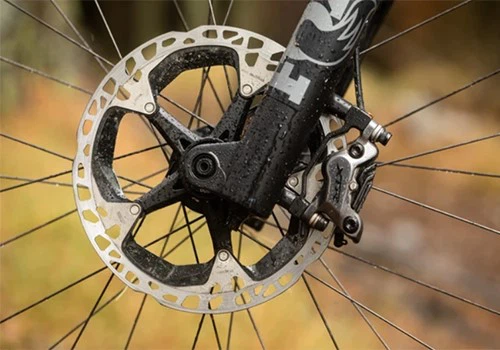
Most discs are made of high quality stainless steel, not only the brake surface is strong and durable, but also all-weather available. The disc surface has a lot of skeletonization, which helps water, mud and small debris come off quickly. These designed and properly lined up holes also provide weight reduction.
One of the major design imperatives of the disc is heat dissipation, and there are many ways to achieve this claim. Some discs are coated with heat sink material on the inner rim, others are thicker like SRAM's latest mountain discs to achieve heat dissipation, and others are like motorcycle discs with a stainless steel outer rim attached to an aluminum inner rim. Shimano's IceTech is a thin layer of aluminum sandwiched between two pieces of stainless steel to accelerate heat dissipation.
4. Installation standards: center lock vs. six nails
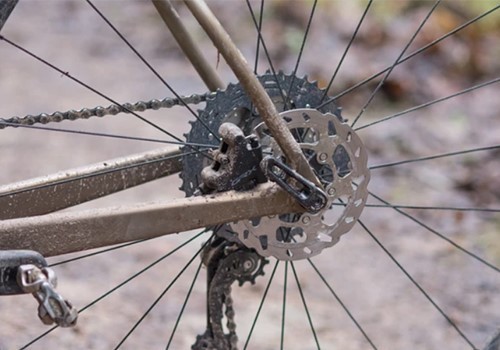
To brake strong, the installation must be firm. The two common ways to install discs are mid-lock and six-pin. The most common is the latter, through the six screws to screw the disc on the hub, not only light weight and simple structure, there are hands on the line. There is also the mid-lock, where the disc is first set on a specific position on the hub, and then the screw cap is screwed on, which requires a specific tool.
5. How often to change?
Like the lining, the disc is a consumable part, every time you pinch the brake, you will lose a little bit, so you need to replace it after years and years. Shimano recommends a 1.8 mm thick disc to be replaced as soon as it is worn down to 1.5 mm; SRAM recommends that it be replaced as soon as it is worn down to more than 0.3 mm, or if the thickness is less than the amount indicated on the surface of the disc.