

When gravel riding began to take off, bikes were often fitted with 35mm tyres. Over time, 700x40c became the norm. But now new models are designed to accommodate 45 and even 50mm tyres, which is often what competitive riders want. This trend is not just happening in gravel, but in road cycling as well, and even before that, in mountain biking.
Why are wider gravel tires faster?
Wider gravel bike tires are often faster for several key reasons, especially when you're riding on mixed or rough terrain. Here's a breakdown of why this happens:
1. Lower Rolling Resistance
Wider tires have a larger contact patch with the ground. At first, this might sound like it would slow you down, but it actually helps reduce rolling resistance on rough or loose surfaces. When the tire is wider, it doesn't sink into soft surfaces (like gravel or dirt) as much as a narrower tire would. This means the tire can roll more smoothly over the surface, resulting in less energy spent on overcoming bumps and irregularities.
2. Better Traction
Gravel and off-road surfaces can be unpredictable, with loose gravel, mud, and uneven terrain. Wider tires provide more grip because they can spread the force across a larger area. This increased traction helps maintain speed without skidding or losing control, especially on loose gravel or wet conditions.
3. Lower Air Pressure
Wider tires can run at lower air pressures without risking pinch flats or bottoming out. Lower pressures help smooth out the ride and reduce the impact of rough surfaces. The ability to run lower pressures means the tire deforms more efficiently to the ground, increasing comfort and control, while still maintaining speed.
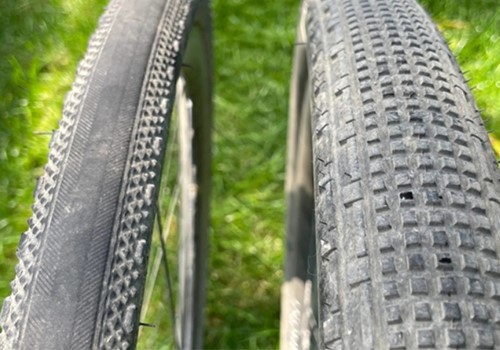
4. Better Shock Absorption
Gravel bikes with wider tires have better natural suspension qualities. They can absorb more of the bumps and vibrations from the terrain, keeping your body in a more efficient position over time, preventing fatigue, and enabling you to keep up a higher pace.
5. Enhanced Stability
Wider tires provide a larger footprint, which helps improve the overall stability of your bike. On uneven or rocky gravel paths, stability is key for both safety and speed. A more stable bike means less time spent correcting your line or struggling to stay upright.
6. Speed on Different Surfaces
While narrower tires might feel faster on smooth asphalt, gravel surfaces tend to slow down narrower tires due to the increased rolling resistance. On rougher surfaces, wider tires can maintain momentum better, meaning you don't have to work as hard to sustain speed.
7. Lower Risk of Flats
Wider tires tend to be more resistant to pinch flats because of the increased volume of air they hold. This means you can focus on maintaining speed instead of worrying about tire damage or pressure, which could interrupt your ride.
While narrower tires are generally faster on smooth, paved roads, wider tires are often faster and more efficient on gravel or mixed terrain because they handle rough surfaces with less resistance, more grip, and better shock absorption. The tradeoff is that they might not be as fast on smooth pavement, but for gravel riding, they tend to outperform narrower options over long distances and varying conditions.
This phenomenon is particularly evident in mountain biking, where 2.4-inch tires are commonplace in pure competition events such as XCO Olympic Cross Country, Marathon Cross Country and short track. Road cycling has not been immune to the trend of larger tires: the standard 700x23c tires at the beginning of this century were replaced by 25mm, 28mm, and after Tadej Pogačar used 700x30c tires in last year's Tour de France, this size is about to become the new normal. Only cyclocross is restricted by the 33mm regulation limit.
Clearly, gravel cycling cannot be excluded from the "tire fattening" movement, especially when laboratory tests confirm what has long been proven in other fields: wider tires reduce rolling resistance, especially on rough surfaces.
Key principles of efficiency
The core mechanism for the improvement of wider tires in various fields is the same: by reducing the bounce and short-term ground clearance caused by uneven surfaces, so as to avoid the loss of pedaling power in these microseconds.
Laboratory tests of different wheel sizes have proven that small-volume tires only have an advantage on absolutely flat roads. In fact, even a 29x2.2-inch mountain bike tire has less rolling resistance than a typical gravel tire-the current 35mm tire designed for all-terrain has a resistance difference of up to 42 watts compared to a mountain bike tire.
Weight vs. Resistance
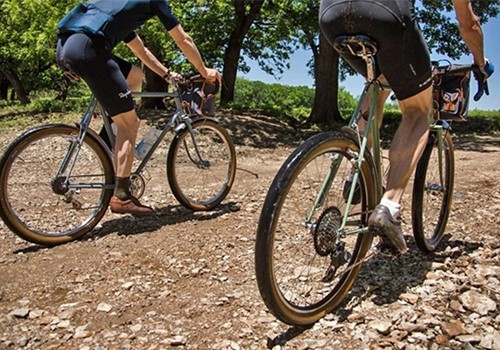
The traditional view is that the disadvantage of wide tires is the increase in weight. But the power increase required to drive the extra weight is far less than the rolling resistance loss saved by the increase in tire volume. What's more, wide tires do not require an overly reinforced carcass structure, but can achieve lighter weight and high flexibility, which further optimizes rolling performance.
Advantages beyond power data
In typical gravel events, which are often very long, wide tires have another key advantage: they greatly improve riding comfort by allowing lower tire pressures without losing rolling efficiency.
These advantages have been widely recognized by gravel competitors. The scene of the top riders at the first Gravel World Championships all using road bikes equipped with road-cross tires may become history. In fact, the specifications of 700x45c to 700x50c have become the norm in events, and some riders will even directly choose XCO mountain bike tires if the track is technically difficult.
The only unknown is where this "tire fattening race" will end? Perhaps technology is a reincarnation. If it continues, gravel bikes may lose their multifunctional nature and eventually follow the path of mountain bikes.