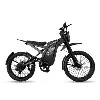

As for the development history of China's electric bicycles, the industry generally agrees that there are three stages of development: the initial stage of electric bicycles, the initial stage of large-scale production, and the stage of overspeed development.
The primary stage of electric bicycle is also called the early experimental production stage of electric bicycle. In terms of time, it is from 1995 to 1999. This stage is mainly about the exploration and research of the key technologies of the four major parts of the electric bicycle, motor, battery, charger and controller. In terms of R&D and production, the production enterprises spontaneously collected information, tracked technology, organized market observation, and launched small batches of market trials, which also made electric bicycles come into the view of consumers and gradually recognized and accepted by them. Technically speaking, early electric bicycles could only travel about 30km with new batteries charged at a time. The battery life was short, the climbing ability was poor, and they were easy to wear. Moreover, the motors were all brush and toothless motors. However, the accumulation of this period has laid a good foundation for the scale of industrialization in terms of talents, technology and product research and development.
The reason why the second stage is called the initial stage of large-scale production is that there are several opportunities to promote electric bicycles in this period, which makes the electric bicycles that are struggling in the initial stage usher in the spring. What's more, the development of the industry has entered a large-scale stage. Among these opportunities, the most valuable ones are the "prohibition order" of each city and the "SARS" in 2003
This period is generally recognized as the period from 2000 to 2004. During this period, with breakthroughs in key technologies and continuous improvement in the performance of electric bicycles, electric bicycles have become a substitute for motorcycles and bicycles. Its fast, environmentally friendly, convenient and cheap features also stimulate the market's demand for electric bicycles. In the growing market demand, the former R&D and production enterprises have risen rapidly, and some new enterprises have also started to enter. Their investment in electric bicycles has also been increasing, making the production capacity expand rapidly (see Table 1.1 for details). Moreover, the enterprises that have sprung up rapidly in this period are all operating with great efforts, leaving behind the older generation of R&D and production enterprises. However, some large-scale enterprises represented by famous brands have been formed, and according to the difference between the north and south, three industrial clusters represented by Wuxi, Zhejiang and Tianjin in the industry have also been formed.
The third stage is from 2005. This stage is the development stage of China's electric bicycle, which is nicknamed "blowout stage" by the industry. During this period, the fierce competition among enterprises has greatly stimulated the progress of technology and the diffusion of new technologies. The technical level of the whole industry has been greatly improved. The battery life and capacity have been increased by 35%. The motor has developed from a single brush and tooth motor to a brushless high-efficiency motor. The service life has been increased by 5 times, the efficiency has been increased by nearly 30%, and the climbing and load capacity have been increased by 3.5 times. While the performance is improved, the manufacturing cost is also greatly reduced, and the price power is reduced to 21%; In the controller system and charging system, the technical level has also been greatly improved. In particular, great progress has been made in battery technology and motor technology. The technical breakthrough of lead-acid batteries for electric vehicles has led the world, and Zhejiang Changxing plate led by Tianneng and Chaowei, Jiangsu plate represented by Kang Lien and Shuangdeng, and Guangdong plate represented by Ruida have been formed. The battery also has a single lead-acid battery, which can be used in many types of high-performance batteries, and the emergence of lithium batteries has further driven the development of electric bicycles, especially simple ones. In terms of motor, the invention of permanent magnet brushless motor has significantly accelerated the pace of industry development. The key of motor performance is the performance of strong magnetic materials. Among all kinds of permanent magnetic materials, rare earth permanent magnetic materials have the best performance. China is recognized as the world's largest country of rare earth resources and manufacturing power of rare earth products. Due to the good performance, low price and strong manufacturing capacity of rare earth strong magnetic materials, the expensive BLDC (Brushless DC Permanent Magnet Motor) system in the international market has been widely used in Chinese enterprises. Therefore, the electric bicycle industry has gained unique resource advantages. From the perspective of the total production and sales volume of the industry, in 2005, the total output of various light electric vehicles (including electric bicycles) of hundreds of enterprises across the country is expected to exceed 9 million, the export of about 2 to 3 million, the industrial output value of 20 billion, the profits and taxes of about 6 billion yuan, and the employment in related production and service fields of nearly 1 million people. China's production and sales of light electric vehicles have accounted for more than 90% of the world's total, and China has become the world's largest producer, consumer and exporter of light electric vehicles.