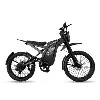

1、Types of front fork
The bike front suspension forks is one of the front part of the bicycle structure, and its main function is shock absorption. There are generally 3 types, namely: spring fork, oil spring fork and oil pressure air fork.
|
|
The structure is simple, usually with springs on one or both sides, and the adjustment function is obtained by compressing the springs while losing travel. |
|
Oil spring front fork |
The oil damping is added to the structure of the spring fork, so the speed of rebound is obtained, and the lockout function can also adjust the rebound speed on the basis of adjusting the softness and stiffness. On flat roads or climbing, the lockout function can reflect the greater advantage of the heavier. |
|
Hydraulic air fork |
On the basis of oil spring fork, the spring is replaced with air pressure, and the stiffness is adjusted by pump, with rebound and locking function, and lighter weight. |
For beginners, you just need to know the types of forks, how to set the air pressure of the fork, pre-pressure travel, compression damping, rebound damping need a long time riding to properly set the right one for yourself. A simple beginner doesn't need too much fuss, and a spring-loaded single fork can meet the various needs of a beginner. Choosing a high-level fork means you need to have plenty of time to adjust and maintain the fork.
2、Fork travel
Usually, less fork travel means lighter, faster uphill mountain, and more fork travel equals better downhill ability.
The length of fork travel can represent what type of mountain bike it belongs to.
|
Length |
Type |
Road Type |
Summary |
|
60-110mm |
Cross-countryrace bike(XC) |
Forest paths, trails |
The XC prefers to use larger diameter wheels, combining light tread, low volume and fast turning tires to achieve top speed. |
|
110-130mm |
Cross-country/trail bike(XC/Trail bike) |
Full Functionality |
Between XC and trail bike, it combines the advantages of both, with fast and efficient climbing performance and excellent downhill ability. |
|
130-160mm |
Trail bike |
Designed for riding on a variety of terrain in the mountains |
This is the most popular model with an almost universal drivetrain. |
|
160-180mm |
Enduro bike |
Track and Bike Park Circle |
Enduro bikes are typically used for racing competition, have more travel than regular Lindau bikes, are almost exclusively softtailed, have their downshift performance tuned by extensive damping adjustments, and are increasingly trending towards coilover shocks for lower maintenance. |
|
180-200mm or more than 200mm |
Downhill race bike |
The fastest, roughest descent ever! |
In order to withstand the specific impact of the drop, the support legs of the fork are extended above the head tube, becoming a "double crown" or "triple fork" |
3、Manipulation of the fork
Fork operation function is generally divided into 2 kinds, not lockable and lockable.
Not lockable as the name implies, is not adjustable, can not be locked.
After the fork is locked, it does not have the function of the shock. In the flat road riding or climbing time will be more energy saving.
Lockable is divided into two kinds, one is the shoulder control lockable and the other is the line control lockable.
Shoulder control is to lock the button on the fork, you need to screw by hand, lock the fork.
Line control is a lock button on the handlebar, you only need to use your finger to lock the fork.