

Stiffness (as opposed to strength) of any bike is important to pedaling efficiency, especially when going uphill or trying to get ahead. It can be defined by the finite amount of deformation or flex of the entire vehicle caused by the forces applied to the pedals while the tire is actually and instantaneously "fixed" to the road. The finite deformation or flex of the whole bike includes: tires, their cross-section and pressure, rims, forks, cranks, handlebar system and seatpost, etc., but most importantly the frame itself! The energy that caused these deformations is essentially irretrievably lost from the basic purpose of propulsion. Monotube folding frames flex more under load than traditional front triangle frames - no surprise!
How to define and measure the stiffness of a frame is not a simple problem. Many people have tried. First, we must quantitatively define "frame deflection", which is actually distributed among many tubes and stores energy. Fortunately, most of these tubes connect directly or indirectly to BB tubes. Since the solid BB tube is where the force is applied, we can conveniently observe its displacement. In our model, we propose to measure the observable displacement of the BB as a definition of the total amount of deformation energy - which will be tested experimentally.
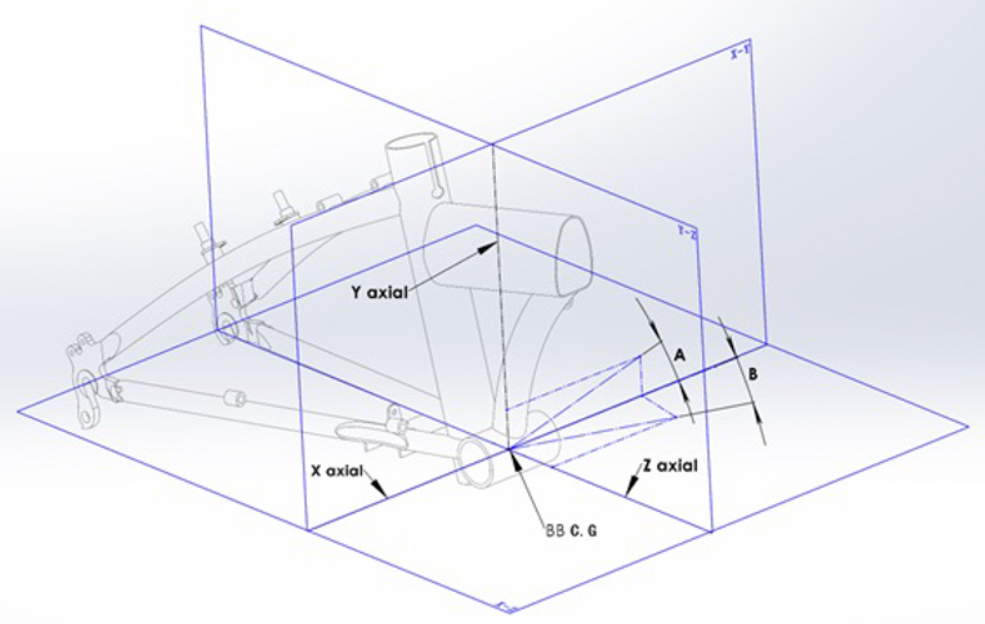
Like any entity in physics, BB has 6 independent degrees of freedom, usually orthogonal X, Y, Z (linear) and A, B, C (angular), as shown in Figure 3. Obviously, since there is no force-applied component in the test, the displacement in the Z direction is negligible; C is zero due to the BB's bearing. So, there are 4 distinct deformation dimensions and are recorded from the force applied to the pedal. The first pair of deformations are temporary X and Y displacements about the center of gravity of the BB tube; the second pair is the rotation of the BB tube, represented by the angles A and B of the Z front-back axis and the Y vertical axis. These four deformation dimensions are "linear" (proportional to the applied force, returning to the original position after the applied force is removed without permanent deformation) by definition in classical physics. These degrees of freedom and deformations are mostly independent and must be considered separately, and according to classical physics, their stored energy is additive. For the purposes of this study, there may have been small cross terms, but these were ignored.
Tianjin Panda Group will continue to improve the research on bicycles and manufacture more mountain bikes that meet the needs of cyclists.