
Although cable-actuated disc brakes have been criticized for never being able to match the feel and efficiency of hydraulic disc brakes, they are not completely hopeless and can still be significantly improved through simple upgrades and adjustments.
To make the performance of the cable-pull disc brake (mechanical disc brake) better, you can optimize and adjust the following aspects, covering key factors such as the brake itself, cable, installation and maintenance:
1. Choose high-performance brake components
Brake pads:
Replace with sintered metal or hybrid brake pads, which are more resistant to high temperatures and have stronger braking force than resin brake pads, and are suitable for humid or heavy-load environments.
Make sure the brake pads match the discs (check brand compatibility).
Discs:
Use larger diameter discs (such as 180mm) to increase braking torque.
Choose discs with better heat dissipation (such as those with cooling fins) or stainless steel to reduce thermal decay.
2. Optimize brake cables and cable tubes
Cable upgrade:
Replace with high-quality compression brake cables (such as Shimano SP41 or Jagwire Pro) to reduce friction and elastic deformation.
Choose Teflon-coated inner cables to improve smoothness.
Cable tube treatment:
Try to shorten the cable tube length and reduce bends (avoid sharp bends).
Use low-friction pulleys or stoppers (such as Problem Solvers' cable guides) on cable bends.
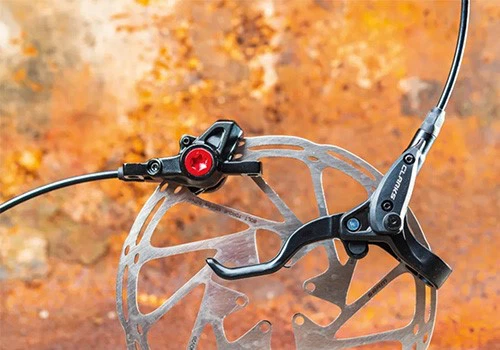
3. Adjust the brake system
Align the caliper:
Make sure the brake caliper is centered and the rotor does not rub against the brake pads (adjust the caliper set screw or use shims to fine-tune).
Loosen the caliper set screw, squeeze the brake lever and then re-tighten it to help self-center.
Adjust the brake travel:
Shorten the brake travel and improve the response speed by adjusting the adjustment knob on the caliper or the fine-tune screw on the brake lever.
Make sure the brake cable tension is sufficient (tighten the cable set screw after tightening).
Optimize the leverage ratio:
Choose a long-arm brake lever (such as TRP RRL) to increase mechanical advantage for users with weak hands.
4. Reduce friction and drag
Lubricate the cable and inner cable:
Regularly inject a cable lubricant (such as Finish Line Teflon), especially after rain or long-term use.
Check the cable ends:
Make sure the cable cut is smooth and free of burrs (use a dedicated cable cutter).
5. Regular maintenance
Clean the disc and brake pads:
Use isopropyl alcohol to clean the disc to avoid oil contamination (oil can cause a sudden drop in braking force).
If the brake pads are stained with oil, sand them with sandpaper or replace them directly.
Check wear:
Replace brake pads that are not thick enough (usually marked with wear indicator lines).
Make sure the disc thickness is not less than the minimum standard (usually 1.5mm).
6. Advanced modification (optional)
Double-action calipers:
Upgrade to dual-piston cable-actuated disc brakes (such as TRP Spyre), which push the brake pads on both sides synchronously for more balanced braking force.
Shift/brake cable splitter:
For drop-bar road bikes, use a cantilever splitter (such as Travel Agent) to improve the cable angle.
7. Riding technique assistance
Anticipate braking: Preheat the brake pads by braking lightly in advance, especially in slippery conditions.
Avoid long-term drag brakes: use point brakes when going downhill to prevent overheating.
Common Problems Troubleshooting
Brake feel soft: Check whether the cable tube is aged, whether the inner cable is stretched, or the caliper is not tightened.
Abnormal noise: Clean the disc, check whether the brake pad is worn or the disc is deformed.
Slow rebound: Lubricate the cable tube or check the spring tension (whether the caliper piston returns normally).
Through the above steps, the performance of the cable-pull disc brake can be significantly close to the level of hydraulic disc brakes, especially in response speed and braking force. If you are still not satisfied, you can consider upgrading directly to hydraulic disc brakes (brakes and hand levers/handles need to be replaced).